November 5, 2022
Scripture Lies at the Heart of Adventism
The appearance of the first volume of the new Seventh-day Adventist International Bible Commentary (SDAIBC) series rep-resents an important moment in Adventist biblical scholarship.
by
Gerald A. Klingbeil

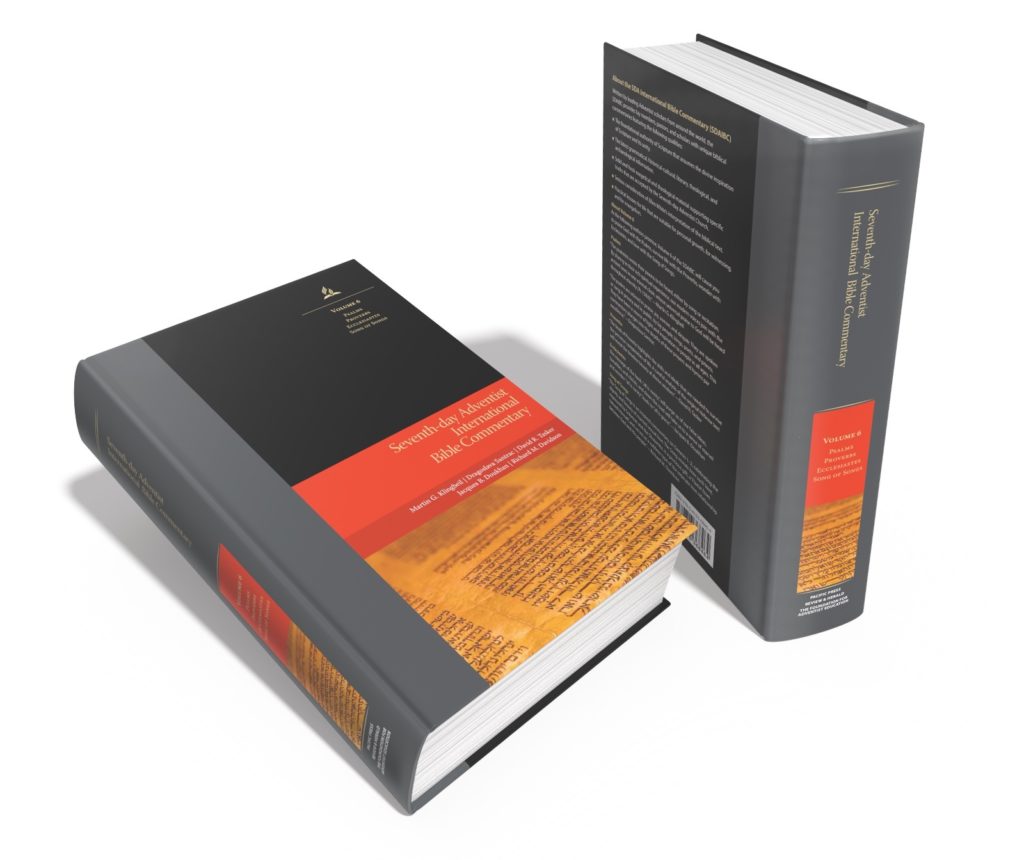
Martin G. Klingbeil, Dragoslava Santrac, David R. Tasker, Jacques B. Doukhan, and Richard M. Davidson, Seventh-day Adventist International Bible Commentary: Volume 6: Psalms, Proverbs, Ecclesiastes, Song of Songs (Nampa, Idaho: Pacific Press Pub. Assn./Review and Herald Pub. Assn., 2022), xxix + 1391 pages, hardcover. US$59.99, available on AdventistBookCenter.com. Reviewed by Gerald A. Klingbeil, associate editor, Adventist Review Ministries.
The appearance of the first volume of the new Seventh-day Adventist International Bible Commentary (SDAIBC) series represents an important moment in Adventist biblical scholarship, and, following soon after the publication of the two-volume Andrews Bible Commentary (2020, 2022), highlights the significant contribution of dozens of Adventist Bible scholars hailing from all corners of the world and representing a global church community.
Many years in the making and nearly 70 years after the publication of the original Seventh-day Adventist Bible Commentary (1953-1957), the SDAIBC fills an important need for a growing church engaged in the serious and faith-based study of the biblical text. It takes into account new archaeological, historical, textual, cultural, and chronological insights and discoveries that help illuminate and enrich our reading of Scripture. Furthermore, while the original Adventist Bible Commentary set featured an overwhelming majority of North American Bible scholars, the SDAIBC reflects more closely a vibrant and growing international faith community sensitive to cultural differences, yet united in its high view of Scripture. Contributors for volume 6 hailed from Germany, Serbia, Australia, France, and the United States.
The fact that the first full volume published after the appearance of the initial single commentary on Genesis (in 2016) focuses on Israel’s hymns and wisdom literature may be accidental, yet it’s also a welcome reminder that personal piety and practical Christianity are key elements of God’s Word.
The Structure of the SDAIBC
The volume contains a short foreword of the editors (pp. vii, viii) describing the twofold audiences the new series seeks to engage, namely pastors, seminary students, and theologians and Bible teachers, as well as nonspecialists seeking a deeper understanding of the biblical text. This is followed by a brief “How to Read the SDAIBC” section (pp. ix, x), a useful glossary of technical terminology (pp. xi-xix), a list of Hebrew grammar terms (p. xx), a list of abbreviations (pp. xxi-xxvii), and a table showing the utilized transliteration scheme for Hebrew and Greek letters (pp. xxviii, xxix).
The commentary for each biblical book follows general introductory categories (e.g., author, time, place, situation, genre, literary structure, theology, and intertextual use in later biblical books), and concludes with a selected bibliography annotated by the author of the particular commentary.
Half of this volume of the SDAIBC (c. 700 pages) is dedicated to the commentary on the Psalms, authored by two scholars (Martin Klingbeil [Pss. 1-75] and Dragoslava Santrac [Pss. 76-150]).* As noted by the two authors, this division is based, not on an internal structure in the book of Psalms, but the length of Israel’s hymnal and the often-limited ability of scholars to carve out enough time for research and writing. The commentary for each psalm (or chapter in the case of the other books that form part of volume 6) includes a concise summary statement highlighting the most important ideas, structural devices, and theological themes, followed by two parallel versions of the biblical text (NKJV and ESV) organized in clearly demarcated sections. Next come relevant and more specific exegetical discussions.
The SDAIBC contains a number of images and excursuses, as, for example, a seal impression found in 2009 in Jerusalem (though only correctly identified in 2015) that bears the name of King Hezekiah (p. 294) and has significance in the scholarly debate about the winged sun disk visible on the seal impression and its relationship to the use of sun metaphors in Scripture. Important excursuses include a discussion of form criticism (pp. 15-17), a review of the distinct metaphors of God used in the Psalms (p. 21), a discussion of the messianic perspective of Proverbs 8 (pp. 774, 775), and a long and helpful excursus reviewing the flora of the Song of Songs (pp. 1180-1195), to mention just a few.
Using the SDAIBC
Many commentary pages include one or more footnotes, offering references or more technical explanations of linguistic details, and engaging in the important task of entering into a conversation with other scholars and opinions. These conversations are not evenly spread out in the volume— possibly a reflection of how different authors perceived the assignments given to them. More evenness in this aspect may have been a good idea and may be considered for future volumes.
The first complete volume of the SDAIBC offers both specialists and nonspecialists copious material for reflections and further research. It represents the best of Adventist biblical scholarship engaging faithfully with the text and world of Scripture and reminds the attentive reader of the fact that there is always more to discover when we dig deeply into God’s Word. Scholars will sorely miss a number of relevant indices (such as biblical and extrabiblical text references, modern authors cited, etc.)—which may, perhaps, appear in the final volume of the set, even though that may not be the best location. Others will quibble with an interpretation of a particular detail or would wish for more in-depth discussion of a particular text or chapter (as I did for the commentary on Psalm 119). All will be grateful to the individual authors and the editorial team led by Jacques Doukhan for a significant tool that invites us back to look and relook at Scripture and that challenges us to keep reading and listening to the Word to finally connect to the living Word offering us the peace of God that truly transcends all understanding (cf. Phil. 4:7).
* Full disclosure: Psalm specialist Martin Klingbeil is my brother.
About the Author

Gerald A. Klingbeil
Gerald A. Klingbeil, D.Litt., has served the Adventist Church for more than three decades internationally as a professor and editor. He now lives with his wife, Chantal, close to the beautiful city of Hamburg, Germany, where he serves as CFO of the Hanseatic Conference of Seventh-day Adventists.
Sign up for the newsletter
Get the latest Adventist news straight into your inbox.
Follow us:
Related

A Broad Wealth of Ideas and Biblical-Ethical Counsel
This volume comprises 20 chapters by 22 authors on a range of technology-related topics.
Eric Louw
July 28, 2026

Gerhard Pfandl’s “Sola Scriptura”
This book offers a brief but comprehensive overview of how sola scriptura became a key tenet in Protestant thought, and why that remains important for us.
Shawn Boonstra
May 27, 2026

Charlie Kirk’s Stop, in the Name of God
The book will help people learn about the Sabbath and the Adventist Church. Some will be led to honor the Sabbath. Others will use his book to champion blue laws.
Joe Reeves
December 22, 2025

How’s Your Heart?
Grandpa is going in for his procedure this week,” my mother shared quietly as we sat together on the couch. My elderly grandfather was going in for a second carotid artery stent, a relatively routine procedure but one his surgical team took seriously. “We need to pray it goes smoothly,” she finished. Any cardiovascular procedure … Continued
Beth Thomas
January 30, 2023
Comments
Advertisement
